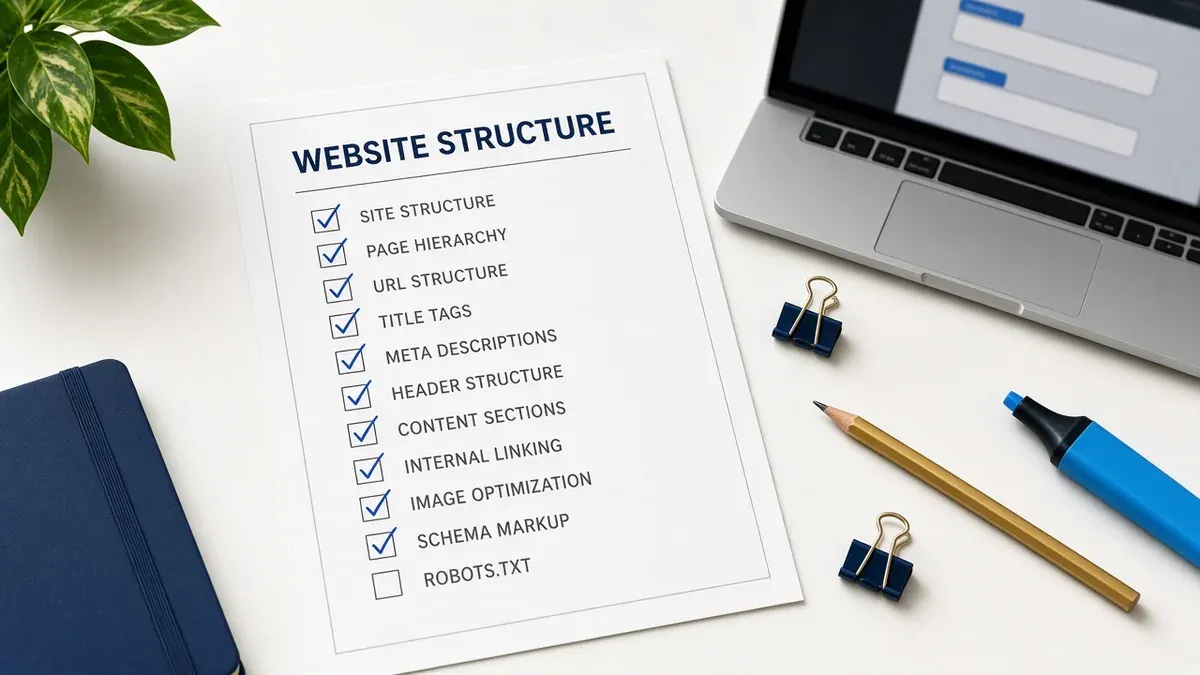
Website Titles, Headings, Meta and Schema Checklist
Search engines and people both need a clear page. Titles, headings, meta descriptions and schema are the labels that make a Kentucky service page understandable. This checklist is practical: what to write, what to check and how American Dreams Marketing puts it in place.
Key takeaways
One clear H1 per page that matches the page topic.
Title tags and meta descriptions written for humans, then trimmed for length.
Heading order that a stranger can skim.
Schema that matches visible content (no invented FAQs).
American Dreams Marketing builds this into your site structure on our platform.
Title tags that say what the page is
A title tag should name the service and the place when it is a local page. Example pattern: "HVAC Repair in Louisville | Your Brand". Keep it under about 60 characters when you can. Do not stuff every town you serve into one title.
How-to: Write the title as if you were answering a neighbor who asked what the page is about in one breath.
Headings people can skim
Use one H1. Use H2s for major sections. Use H3s for sub points. Do not skip from H1 to H4 just to make text bigger. In the American Dreams Marketing site builder, heading levels are part of the page structure Google reads.
H1: the page topic
H2: major sections (services, process, areas, FAQ)
H3: details under those sections
Element | Job | Quick check |
|---|---|---|
Title tag | Search result label | Under ~60 characters, clear topic |
H1 | Visible main heading | Only one, matches page topic |
H2 / H3 | Skimmable outline | Logical order, no skipped levels |
Meta description | Search snippet help | Under ~155 characters, real offer |
Schema | Machine-readable facts | Matches visible text exactly |
Meta descriptions that earn the click
Meta descriptions do not directly "rank" you by magic. They help people choose your result. State who you help, what you offer and what to do next. Mention LaGrange, Louisville or Oldham County when the page is truly local.
Kentucky example: A dentist page might say: Family dentistry in LaGrange with online booking and Saturday hours. Book a visit. That is clearer than a vague line about quality care.
Schema without the mystery
Schema is structured data that helps search engines understand the page. Common types for local sites include LocalBusiness details, FAQPage when you have a real FAQ, and Service pages when the content supports it. American Dreams Marketing uses an owner-approved @graph layout for client sites so the pieces stay consistent.
Never invent reviews, star ratings or FAQs in schema. If it is not visible on the page, it does not belong in the code.
A practical on-page checklist
Confirm the primary topic and city (if local).
Write or rewrite the title tag and H1 so they agree.
Scan H2s: would a stranger understand the page from headings alone?
Write a meta description with a clear next step.
Add or update FAQ only with real questions you answer on the page.
Match FAQ schema to the visible Q&A text.
Check internal links to related services and the contact or booking page.
Guides that help you put this into practice
When you need help drafting clearer page copy or social hooks that send people to those pages, these two guides are a good pair.
Claude for Beginners ($19.99). Getting started with Claude: better prompts for writing, research, summaries and business work.
The Scroll-Stopper Blueprint ($15). Social media hooks, captions and post ideas, with 60+ AI prompts.
Every guide is an instant-download PDF. Full price only. No fake discounts.
How American Dreams Marketing helps
We build and fix site structure on the American Dreams platform: titles, headings, meta fields, canonicals and JSON-LD in our standard layout. We also connect the page to forms and CRM follow-up so SEO work turns into leads you can answer.
Internal links that help people and search
Every service page should link to related services, your contact or booking page, and any proof pages you maintain (projects, about, FAQ). Use natural anchor text. "Book HVAC maintenance in Louisville" is clearer than "click here."
On American Dreams Marketing sites, we map those links while building the page so new content does not become an island. Orphan pages rarely earn trust.
How-to: Once a quarter, open your sitemap and click five random URLs on your phone. If you get lost, fix navigation and internal links before you write more blog posts.
Schema mistakes to avoid
FAQ schema for questions that are not on the page
Review schema without real, visible reviews you are allowed to mark up
LocalBusiness details that disagree with your footer or Google listing
Multiple conflicting JSON-LD blocks pasted by different tools
Our standard approach is a clean @graph layout the owner approves. When we change schema, we keep the visible copy and the structured data matched on purpose.
A one-hour DIY audit you can run today
Search your brand name plus your city. Note the title and snippet Google shows.
Open the page. Confirm the H1 matches that topic.
Count H2s. Do they outline the page?
View source or use a schema tester for FAQ or LocalBusiness marks.
Submit or check the URL in Google Search Console if you have access.
Bring that list to American Dreams Marketing and we will turn it into a fix plan with priorities, not a fifty-item scare sheet.
Examples of strong versus weak page labels
Weak H1: "Welcome to our site." Strong H1: "Residential plumbing repair in Louisville." Weak title tag: "Home." Strong title tag: "Plumbing Repair in Louisville | Brand Name." Weak meta: "We are the best." Strong meta: "Same-week plumbing repair across Louisville and Oldham County. Call or book online."
Those examples are patterns, not invented results. Your real words should name your real services and areas.
LaGrange note: If you serve Oldham County from LaGrange, say that clearly on the page. Do not list every Kentucky city you might someday reach.
How ADM implements the checklist on a live site
Export the current titles and H1s into a working sheet.
Agree on primary topics per URL with you.
Update title, meta and headings in the page editor.
Add or refresh FAQ sections only where useful.
Align JSON-LD with the visible FAQ and business facts.
Publish, then verify on the live URL from a phone.
That workflow keeps SEO work tied to pages people actually open, not a separate document that never ships.
Meta keywords and other distractions
You may still see a keywords field in some editors. It is not a modern ranking lever the way titles, headings, content and links are. We fill useful metadata fields on American Dreams Marketing sites, but we do not waste hours stuffing keyword lists.
Canonical tags, on the other hand, matter when similar URLs could compete. We set canonicals so Google knows which URL is the main one. Social share tags (Open Graph style fields) help your link previews look clean when someone posts your page, which is separate from ranking but still worth doing.
Share preview tip: After a publish, paste the URL into a private browser window and also into a share debugger if you use one. Confirm the title and description look like something you would click.
When those labels are tidy, your how-to content and local proof have a fair chance to do their job.
Heading outlines you can copy as a pattern
Service page pattern: H1 service plus city, H2 what is included, H2 who it is for, H2 areas served, H2 how booking works, H2 FAQ. About page pattern: H1 about the business, H2 who we serve, H2 how we work, H2 meet the team, H2 community notes. Blog pattern: H1 promise of the article, H2 steps or sections, H2 local examples, H2 how we help, H2 FAQ.
You can adapt those outlines inside the American Dreams platform page editor without inventing a new structure every time. Consistency helps your team write faster and helps readers know where to look.
QA step: Ask someone outside your business to skim only the headings. If they can retell what the page offers, your outline is doing its job.
After you change a title tag, view the live page and the browser tab text. Confirm the H1 still matches the promise. Small mismatches confuse people and systems alike.
Frequently asked questions
What is the difference between a title tag and an H1?
The title tag is what Google often shows in search results. The H1 is the main visible heading on the page. They should match in topic, but they do not need identical wording.
How long should a meta description be?
Keep it clear and under about 155 characters so it does not get cut off as often. Write it for humans first: what the page offers and who it helps.
Do I need FAQ schema on every page?
No. Use FAQ schema when the page truly answers a set of questions. Keep the visible FAQ and the JSON-LD text matched.
Can American Dreams Marketing fix titles and schema on my site?
Yes. On-page SEO is part of how we build and improve sites on the American Dreams platform, including titles, headings, meta text and structured data in our standard layout.
Should every page target a different keyword?
Each important page should have a clear primary topic. Related pages can support it. Avoid two service pages fighting over the exact same phrase.
Where do social captions fit in this checklist?
Titles and meta text help search. Social captions help people stop scrolling. Use Claude for longer page drafts and The Scroll-Stopper Blueprint when you need hooks for posts that point back to the page.
Do I need schema on every page?
Start with pages that already have clear visible FAQs or service details. Schema should match what people can read on the page. American Dreams Marketing adds it where it helps clarity, not as decoration on thin pages.
Holiday website special: Websites starting at $1,500. Only three spots are left.
Ready to get this set up?
American Dreams Marketing is a small agency in LaGrange, Kentucky, run by Kristof, an Army veteran. We help local owners with websites, Google presence, CRM follow-up and practical AI tools.
