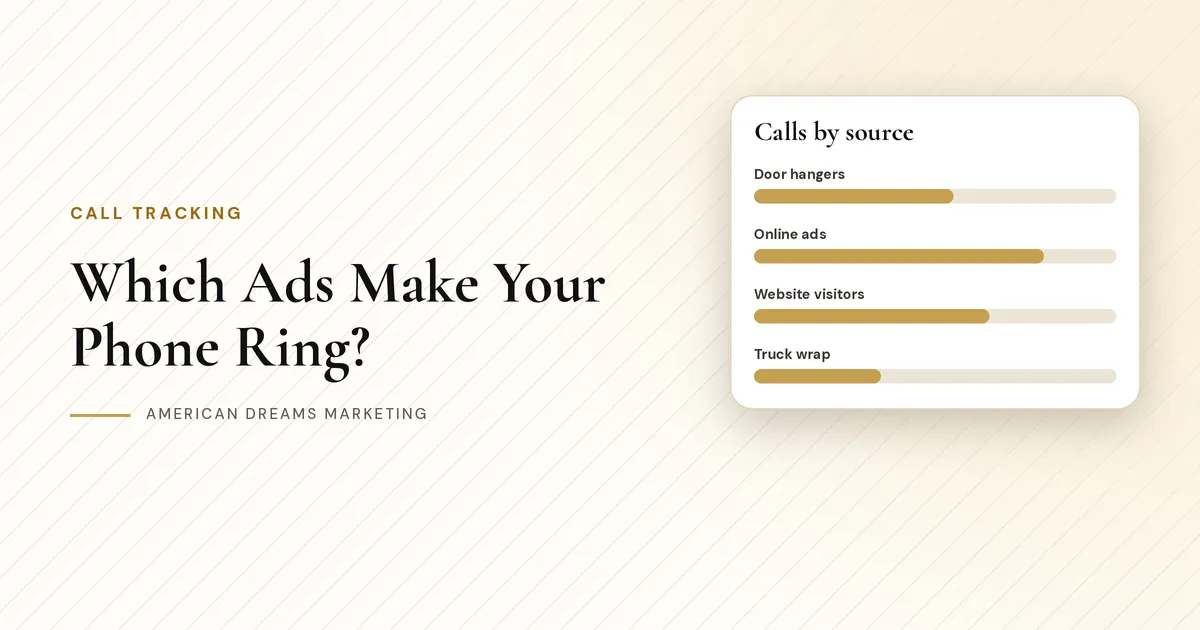
Which Ads Make Your Phone Ring? Call Tracking for Small Businesses, Explained
You pay for a mailer, a few online ads and a truck wrap. The phone rings, you ask how they found you, and the answer is "Online, I think." Call tracking takes the guessing out by giving each source its own number, so you can see which ones bring in calls.
Key takeaways
A tracking number forwards to your real phone. You answer the same way you always do.
Use one number per printed piece or campaign, and number swapping for visitors who reach your website from ads.
Keep your main business number on your Google Business Profile, directories and website.
Compare sources over a few months, then move money toward what rings.
Most small business owners spend money on more than one kind of marketing. A postcard mailer, a few online ads, a sign at the ball field, the truck wrap. When the phone rings, you ask how they heard about you, and half the time the answer is a shrug. So you renew everything, or cut something at random, and hope you guessed right.
Call tracking gives you a better answer. Each ad, flyer or web page gets its own phone number. Every number forwards to the phone you already use. When a call comes in, the system notes which number was dialed, and you get a simple report of calls by source. Here is how it works, the two common setups and how to use it without causing problems for your listings.
How call tracking works
A tracking number is a real phone number that forwards to your main line. The customer dials it, your phone rings and you talk like normal. Behind the scenes, the call is logged with the number they dialed, so you know it came from the postcard and not the ad.
The rule: one number, one source. If a number shows up in two places, you lose the answer.
Where it goes | How to track it | What you learn |
|---|---|---|
Printed mailer or door hanger | A number printed only on that piece | Whether the mailer is worth sending again |
Yard signs or the truck wrap | One number used only on signs | Whether people call from the street |
Online ads | Your website shows a tracking number to visitors who came from the ad | Which ads and search words lead to calls |
Radio, podcast or event sponsor | A number read or printed only there | Whether the sponsorship brings calls |
Good to know: You can hear the source before you say hello
A short whisper message can play only on your end when you pick up, like "Call from the fall mailer." The caller does not hear it. You know where they found you before the conversation starts.
Two setups: a number per source, or numbers that swap on your site
One number per campaign
This is the simplest kind. You get a local number, forward it to your phone and print it on one thing only. It is a good fit for mailers, flyers, signs, radio spots and anything offline. When the campaign ends, you can keep the number running so late callers still reach you.
Number swapping on your website
Online, people arrive from many places at once. A small piece of code on your site can show a number from a pool of tracking numbers to visitors who came from a source you pick, like paid search ads. Everyone else sees your normal number. Pools usually start with a few numbers so each visitor's session can be matched to the right call. With your ads set up to pass along the search words, the call report can even show which search led to the call.
Which one do you need?
If most of your marketing is printed or offline, start with one number per campaign. If you run online ads that send people to your website, add number swapping. Plenty of businesses use both: a few numbers for print and a small pool for the website. Start with the two or three places you spend the most, then add more once you trust the reports.
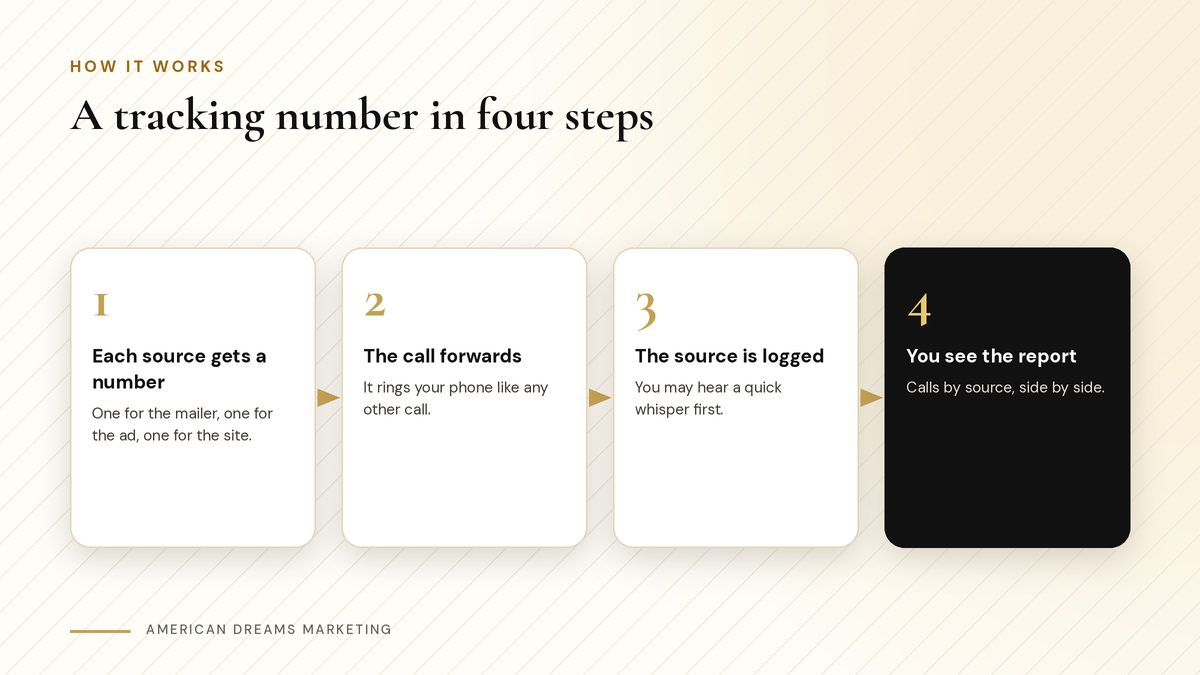
Every number forwards to your phone. The report shows which source made it ring.
Keep your main number where it belongs
Your main business number should stay the same on your Google Business Profile, your directory listings and your website footer. Search tools compare your details across the internet, and a different number in every place makes them less sure who you are.
Use tracking numbers on ads and printed pieces, not on your listings.
Let number swapping handle the website. Your page still lists your main number. Visitors from the source you picked see a tracking number in its place.
Never publish a personal cell as a tracking or forwarding number on anything public. Forward to your business line.
Pro tip: Pick local numbers
When you can, choose tracking numbers with your local area code. A familiar area code looks like a neighbor calling, not a call center.
What to do with the answers
Give it time. Compare sources over a few months, not a single week. Seasons and weather change call volume for many trades.
Look at jobs, not only calls. Each call lands on a contact in your CRM, so you can see which callers became paying customers.
Catch the calls you miss. Tracking shows missed calls too, and an automatic text back can reach those callers while they are still looking.
Train with recordings. If you record calls, listening to a few each week shows how your team answers common questions.
Move your budget. Spend more where the phone rings with real customers, and less where it stays quiet.
Heads up: Recording calls has rules
Laws on recording phone calls differ by state, and some require everyone on the call to agree. If you turn on recording, play a short notice at the start of the call and check what applies where you and your callers are.
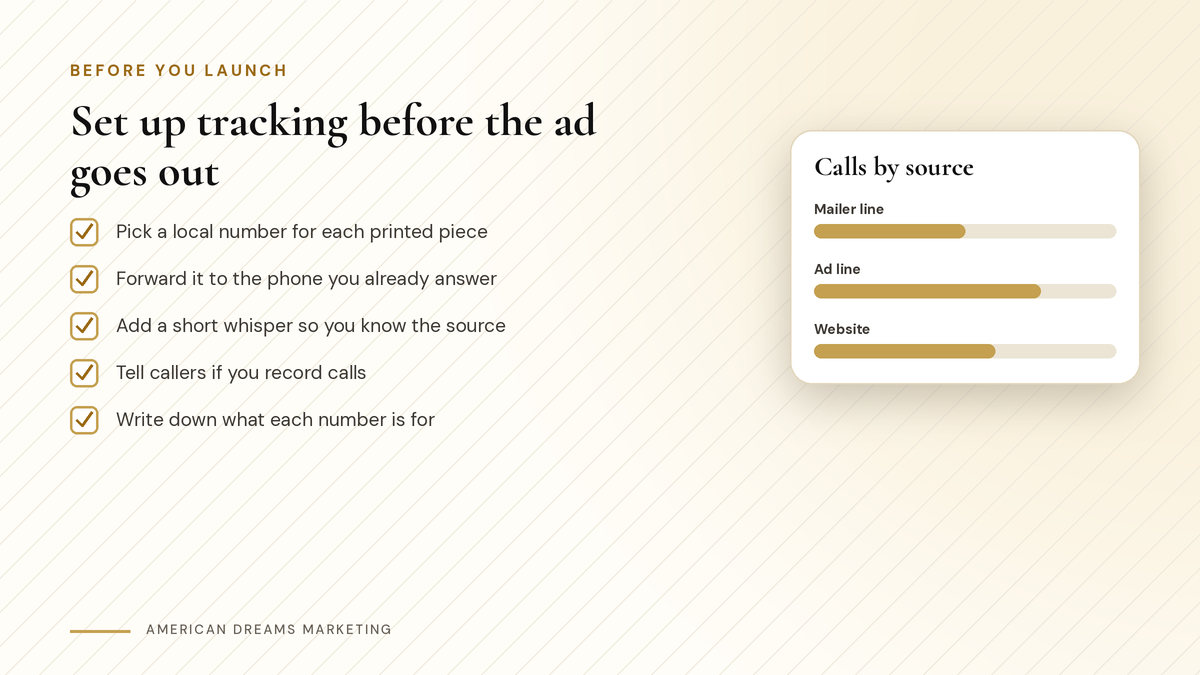
Set up and label each number before anything is printed or launched.
Stop guessing which ad worked. Let the phone tell you.
Missed calls are part of the picture, too. If you are not sure what happens when you cannot pick up, start with our guide to missed-call text back. Then book a free discovery call and we will help you pick which campaigns to track first on the American Dreams platform.
Frequently asked questions
What is call tracking for a small business?
It gives each ad, flyer or web page its own phone number that forwards to your main line, so you can see which sources lead to calls.
Will call tracking hurt my Google ranking?
Keep your main business number on your Google Business Profile, listings and website. Use tracking numbers on ads and print, and use number swapping for website visitors from ads.
Do customers know they called a tracking number?
No. It is a normal local number that rings your phone. A whisper message can tell you the source, and the caller does not hear it.
What is number swapping?
A small piece of code on your website shows a tracking number to visitors who came from a source you choose, like paid search ads, while everyone else sees your normal number.
Can I record tracked calls?
Yes, recording can be turned on with a short notice to callers. Recording laws differ by state, so check what applies to you before you turn it on.
How long before I know which ads work?
Give it a few months so you can compare sources across busy and slow weeks, and look at which calls turned into paying jobs.
Find out what makes your phone ring
American Dreams Marketing sets up call tracking, missed-call text back and call reports on the American Dreams platform, so you can see which marketing brings in real customers. Book a free discovery call to get started.
